Why stretching doesn’t always work
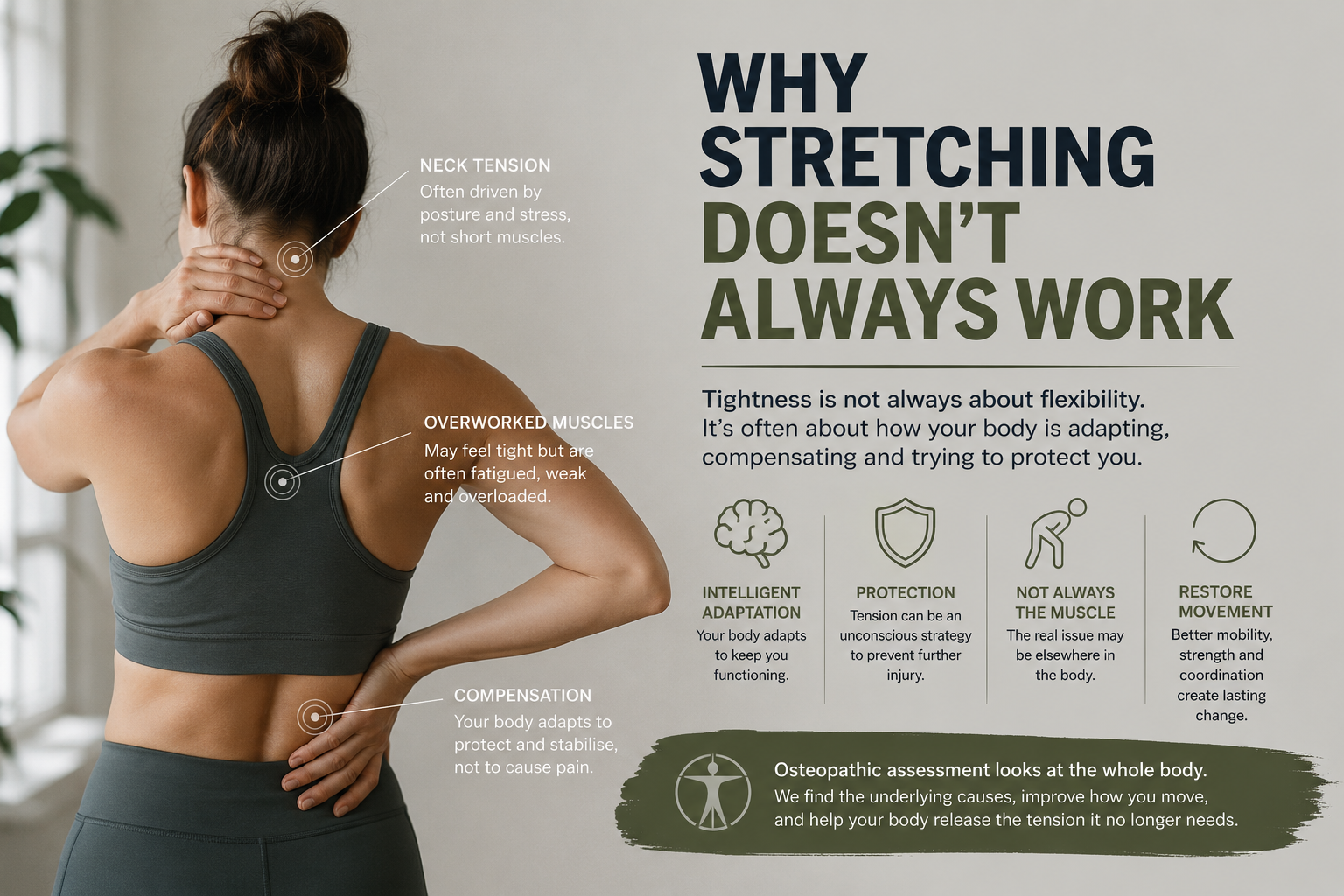
Chronic tightness is not always caused by short muscles. Osteopathy looks at mobility, posture, movement patterns and whole-body compensation strategies to identify why tension keeps returning.
A lot of people assume stiffness means their muscles are too short.
So they stretch.
Sometimes every day. Hamstrings. Hips. Neck. Lower back.
And yet the body still feels tight.
Not just temporarily stiff, but persistently restricted. Heavy. Compressed. Pulled back into the same patterns again and again.
That’s usually because tightness is not always a simple flexibility problem.
The body does not create tension randomly. It often creates it for a reason.
Sometimes a muscle tightens because a joint is not moving properly. Sometimes because another area of the body is weak, unstable or poorly coordinated. Sometimes because the nervous system no longer feels safe or efficient in a certain movement pattern.
And sometimes what people describe as “tightness” is not actually a muscle that is physically short at all.
A muscle can feel tight simply because it has been under constant load for a long time.
Postural imbalances, repetitive movements, old injuries and chronic stress patterns can leave certain muscles switched on almost continuously for years. Those tissues become fatigued, overloaded and sensitised. The brain interprets the ongoing strain as tension or tightness, even though the muscle itself may already be exhausted and overworked.
In these situations, aggressive stretching is not always helpful.
Pulling harder on a muscle that is already chronically strained by constant contraction can sometimes increase irritation rather than reduce it. In some cases it may even expose the tissue to further injury, particularly around the tendons and attachment points where force transfers into the joints and connective tissues.
A lot of people have experienced this without fully realising it. They stretch something because it feels tight, feel temporary relief for a few minutes, then the tension quickly returns. Sometimes even worse than before.
That is often because the body is protecting or stabilising something that you may be unaware of.
The body’s compensations are usually intelligent.
They are not signs that the body is stupid or broken. They are adaptive strategies created by unconscious systems trying to keep you functioning under the stresses, strains and demands of your life, or trying to protect vulnerable areas from further injury.
The problem is that adaptations which are useful in the short term can become deeply ingrained over time.
The body learns habits.
Eventually those habits start to feel normal, even if they are contributing to chronic muscle strain or suboptimal movement.
This is one reason flexibility and mobility are not the same thing.
Mobility is not just about how far a joint can move. It is about how well it moves.
A mobile joint is not simply loose or flexible. It is coordinated, responsive, supported and adaptable. It can transfer force properly through the body. It can move with intelligently proportionate control, not just range.
This is why two people can have the same range of motion, but completely different movement quality.
One body may feel fluid and capable.
The other may feel unstable, guarded or constantly tense.
A lot of modern stiffness is also neurological rather than purely mechanical. The nervous system adapts to stress, repetitive postures, injury history, fatigue, breathing patterns, lack of movement variability, emotional trauma and psychological load.
That is why many people stretch temporary symptoms without changing the conditions that created them in the first place.
Good mobility work tends to focus less on forcing end ranges and more on restoring better movement options through the whole system.
That might involve:
improving joint mechanics
restoring rotational movement
improving rib cage and breathing function
increasing strength and control through neglected ranges
reducing protective tension patterns
improving coordination between different parts of the body
changing repetitive loading habits
Sometimes the tightest muscles are the ones working hardest to hold everything together.
The goal is not always to make the body looser.
Often, the goal is to make the body feel safe enough that it no longer needs so much tension in the first place.
This is one reason osteopathic treatment often approaches stiffness differently from simply stretching isolated muscles. Rather than only chasing the area that feels tight, osteopaths look at how the whole body is moving and adapting together.
Because pain and restriction do not always start where they are felt.
And flexibility alone does not necessarily create healthy movement.
At The BodyWorx Osteopathy in Totnes, treatment is approached from a whole-body perspective, looking not just at isolated symptoms, but at the broader movement patterns, compensations and mechanical stresses that may be contributing to them. A thorough clinical assessment from an osteopath can often help identify mobility restrictions, postural adaptations, movement compensations and areas of instability that you may not even be aware of yourself. By working with the whole body, we can get the whole body working again.
Book now or get in touch with any questions about relieving those tight muscles with osteopathy.